Little Women / Christmas Party

late 1860’s.
Four sisters.
Meg, Jo, Beth, and Amy.
Concord, Massachusetts.
vanity, a hot temper, shyness, selfishness.
dances, play acting, an author, an artist, a pianist.
I won’t spoil any more of it for you… in case you haven’t read it yet!
Little
Women.

It’s the perfect book to curl up with by the fire and read this cold and snowy time of year! If you’ve read it several times or if this is the first time I think everyone will say it’s a wonderful story.

_________________________________________

**This month’s meeting is not on it’s usual day. With busy schedules and many holiday festivities we’re meeting on a WEDNESDAY. December 22 at Jodi’s house at 7pm. AND… it will be the annual Christmas party! Please RSVP if you can make it. (in a comment or to the evite)

Please bring a USED copy of a favorite book wrapped for our book exchange and something to dip on our chocolate fondue! (when you RSVP leave a note of what you’ll be bringing)

Have a joyful, peace-filled December! Hope to see you on the 22nd!!

Who is Louisa May Alcott?

Louisa May Alcott was born in 1832 and taught under her father – essentially she was a homeschooler along with her 3 sisters.  Her education was unconventional due to her father being a Transcendentalists.  Let me retract my previous statement.  She was probably “unschooled” then.  Louisa was often thought of as a tomboy, much like character “Jo” in this month’s novel.

Louisa began writing when she was young.  I imagine her and I would have gotten along quite well.  Already, we share the whole tomboy thing and I bet she and I could sit at a Farmer’s Market, making up all sorts of stories about people walking past us.

However, we become different when it comes to acting.  I do like the lime light, but not as a lurid villain.

Her family suffered a season of poverty which prompted her to seriously earn a living from her writing.  She did this quite successfully.  Although she is most popular for her children’s literature, Alcott explored the themes of self expression and women’s rights through her adult fiction works.

image

(She kind of looks like she has a headache. 

That or she is reading a book.)

But you will have to read those for yourself.  There is an idea for the book giveaway – search for one of Louisa’s adult fiction books.  (I won’t be giving one of you her works.  I already picked up my book at 1/2 Price books . . . it will make you laugh.  At least it did me.)

She wrote over 30 stories.  She followed her father to the grave two days after he died.

In closing,

You have a good many little gifts and virtues, but there is no need of parading them, for conceit spoils the finest genius. There is not much danger that real talent or goodness will be overlooked long, and the great charm of all power is modesty. 

or consider this loosely paraphrased quote regarding her father:

a philosopher was like a man up in a balloon: he was safe as long as three women held the ropes on the ground.

– Louisa May Alcott

Basket of Flowers: A Recap

A week ago Thursday we met to discuss “The Basket of Flowers.”

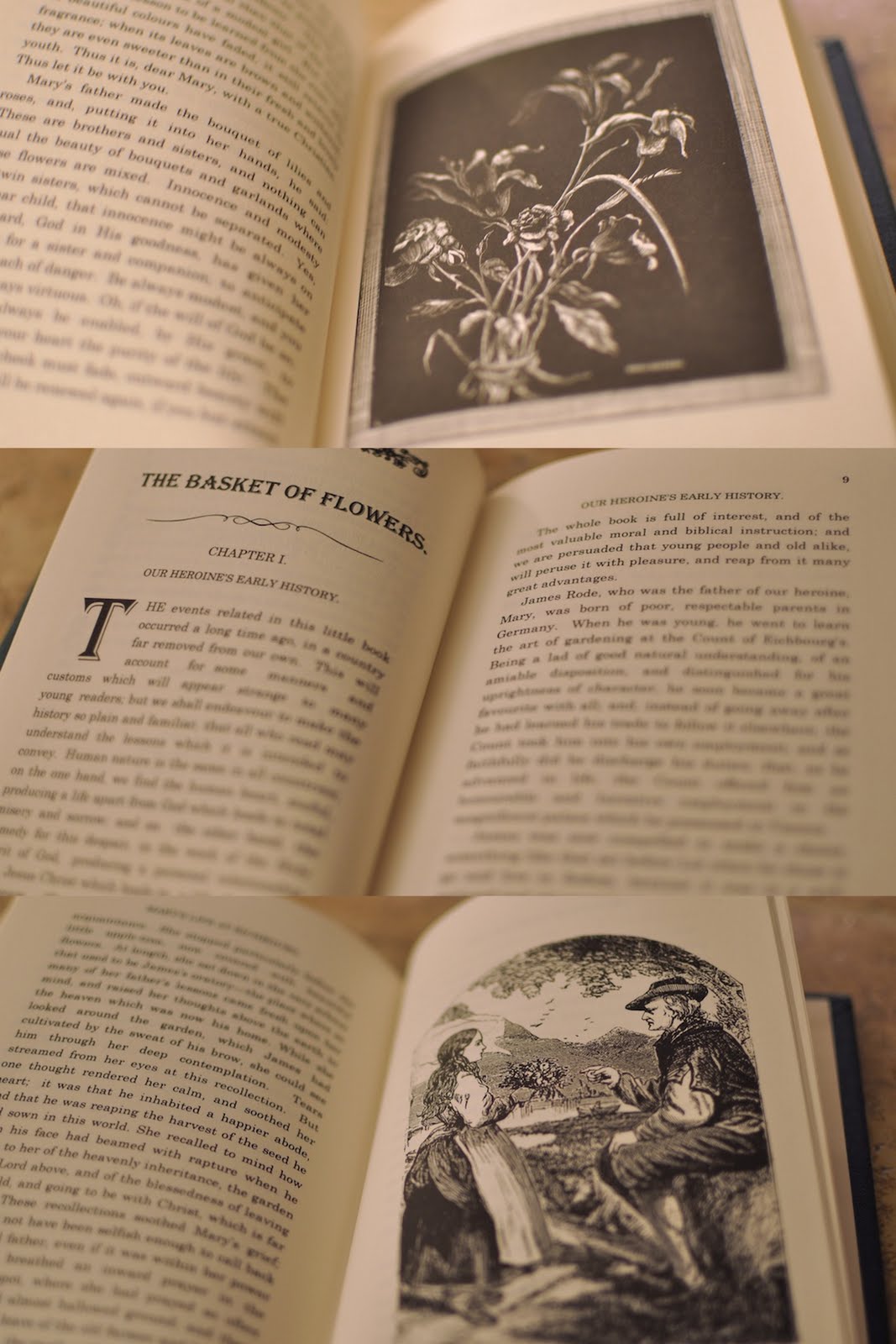
DSC_4059

Funny Story Interlude: I accidentally read “A Flower Basket” which is a story about a fairy with a flower basket. I realized I was reading the wrong book when the previous blog posts said nothing about fairies. oops.

DSC_4078

We had a lovely chat. Drank warm drinks. And smiled at the baby that came along.

DSC_4086

We realized during the discussion that the electronic version had a different ending than the book version. However, each of us seemed happy with the ending that read and would have been disappointed if the version we read had ended the other way.

DSC_4088

The general consensus was that we liked the book, which is why I’m not ruining either ending 🙂 It’s short; go read it for yourself!

IMG_0266

Our next book is Little Women by Louisa May Alcott.
Speaking of little women…

DSC_4097

Discussion Questions: The Basket of Flowers

I hope you’ve enjoyed reading this month’s book, The Basket of Flowers. This sweet story is full of morals and lessons that ring true for readers of any age.

Since a Google search didn’t pull up many discussion questions for this book, I decided to put together a few of my own for us to consider as we get ready for our next book club gathering:

  1. What did you enjoy most about this book?
  2. Was there anything you didn’t like about this book?
  3. What lessons does Mary’s father teach her using the flowers of the garden?
  4. What gift does Mary give her friend Amelia? How do the other characters respond to Mary’s gift?
  5. How does Mary respond when she is accused of her crime? Is it consistent with the lessons her father taught her?
  6. What happens to Mary and her father after they leave their home? How do they respond to their hardships?
  7. What news does Amelia bring to Mary when she is in her darkest hour?
  8. What happens to Juliette in the end?
  9. What do you think about the resolution of the story? Is it realistic or unrealistic, fair or unfair?
  10. What are your lasting impressions of this book?

Do you have any questions of your own or any personal reflections about the book you’d like to share? Bring them to our discussion this Thursday at 7 p.m. at Paradise Bakery and Café. Hope to see you there!

Christoph von Schmid

image I think I would have loved to have been a kid and had this man read me a story.  In fact, he probably didn’t even read his students stories . . . he made them up in real time. 

To be that creative. . .

Christoph von Schmid was a children’s author.  His stories were written for “children, among whom the author daily moved, and were not at first meant for publication.  Usually a story or a chapter was read to the children after school hours as a reward, on condition that they should write it down at home. He thus became familiar with the range of thought and the speech of children, and was careful to speak their language rather than that of books. He was able to observe with his own eyes what it was that impressed the minds and hearts of children both of tender and of riper years.” (From the Lamplighter website)

His writings have been translated into 24 different languages.  How many languages have your words been translated into?  Me?  I’m not sure.  At least one other than English – my blog shows up on my Google Alert in Japanese quite frequently.  Hmmm . . .

The children’s literary champion died of cholera.  He was 87 years old.

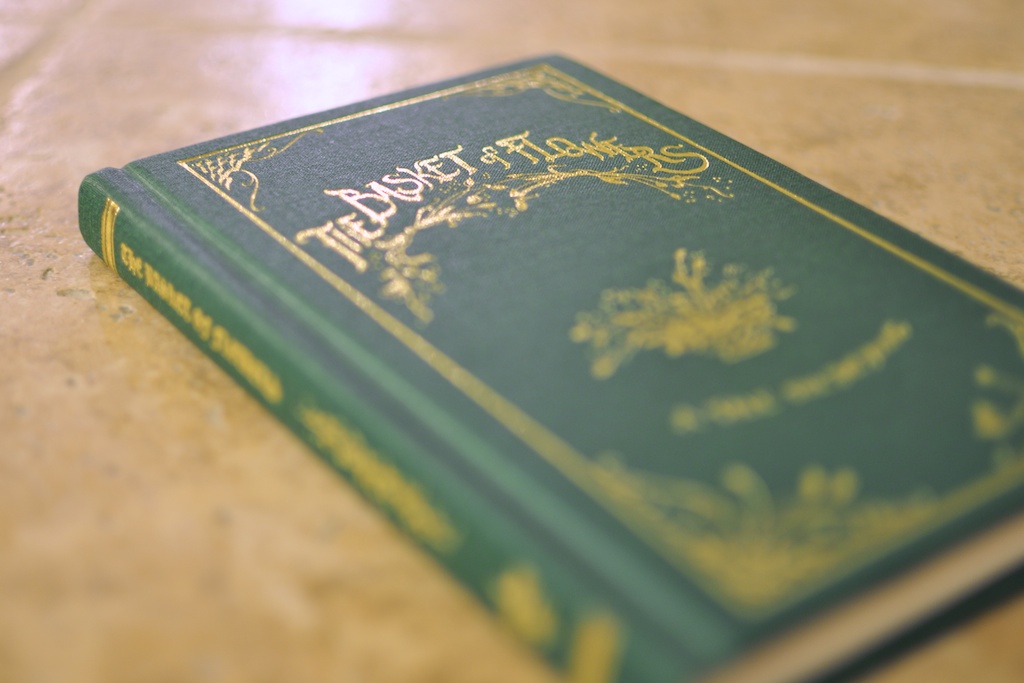
The Basket of Flowers

The Basket of Flowers: An Introduction

A wonderful and short story for this month of Thanksgiving! The subtitle says, “A Tale for the Young” but I’d say this is a story for ALL ages. I can’t wait to read this aloud to Lydia (and Aaron too!)

I don’t want to give away too much of the story, Lamplighter sums it up like this:

James, the king’s gardener, teaches his 15-year-old daughter Mary all the principles of godliness through his flowers. She is falsely accused of stealing, and the penalty is death. Mary remembers her father had taught her: that it is better to die for the truth than to live for a lie, and that the worst pillow to sleep on is the pillow of a guilty conscience! This story will change your life forever!

inspirational.
character building.
full of Biblical truths.
priceless moral lessons.
first published in the 1800’s, it has stood the test of time.


This book is staying in my permanent collection.
This is a book I WILL read again.

We’re meeting to discuss this book two weeks from today.
November 18th.
7:00pm.
Paradise at Hamilton Town Center.

Buy it here from Amazon.
Buy it here from Lamplighter.
Read it free as an ebook here.
Read it free here too.

Frankenstein: a recap

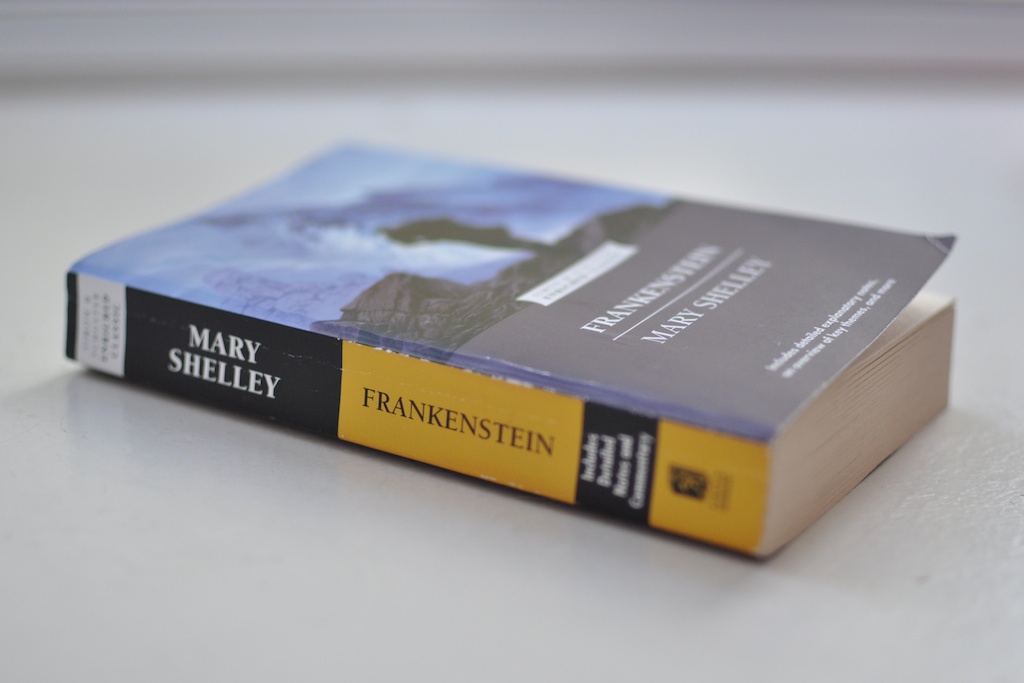
Frankenstein
“It made me use my brain” -Kyndra

I always look forward to book club night!
Thursday night did not disappoint!

My sister and I showed up at the same time…
wearing the same cardigan.
It happens. 🙂

Paradise chai: kept my fingers warm and my tummy happy!

Our conversation covered everything from Frankenstein to Twilight, believe it or not! We even touched on Little Mermaid somewhere in the middle!

There also may or may not have been some singing of “Monster Mash” sometime throughout the evening.

Here are some notes I jotted down while we chatted:

~We would have loved to see how the monster spied on the family of peasants for so long without being noticed! (Personally this was my favorite part. Seeing how he learned about human nature, language and to sense moods and feelings fascinated me!)
~Surprised at how articulate the monster was, what a big vocabulary!
~Was there any residual memories from the brain used in creating him? Just wondering.
~The majority felt sorry for the monster, yet not excusing his actions. None of us felt sorry for Victor.
~Such a willingness to take human life showed a lack of humanity.
~Personally, I thought it would have been helpful if the monster had a big hat. 🙂

Some plot things that left us wondering:

~What happened to Victor’s other brother? Did Shelley leave him unmentioned so she could create a sequel?
~The monster knew to take Victor’s notes when he left right after he was brought to life. How would he know these were important or that he’d ever want them?
~The idea that Victor could even create life was far fetched. Gen. 2:18 says it is not good for man to be alone. Definitely the case for Victor. Although if he hadn’t holed up in this apartment this would have been a short story.


Let me close with this spoiler and a question:
No one got their liver eaten every day.
Who do YOU think was the “champion of mankind” in this story?

Discussion Questions for Frankenstein

Some things to ponder as you read this unusual story from a very eclectic author . . . I am glad my life is a bit (OK a lot)  less dramatic than Shelley’s!

By the way, I think these are pretty good questions . . . they even make you think if you haven’t read the book (which is my current situation!)

  1. Is Robert Walton’s ambition similar to Frankenstein’s, as Frankenstein believes?
  2. Why is the fifteen-year-old Frankenstein so impressed with the oak tree destroyed by lightning in a thunderstorm?
  3. Why does Frankenstein become obsessed with creating life? Was it wrong for Frankenstein to inquire into the origins of life?
  4. Why is Frankenstein filled with disgust, calling the monster "my enemy," as soon as he has created him?
  5. What makes the creature a monster rather than a human being?
  6. Why did Victor create the creature? What responsibilities did Victor, as the creator, have toward his creature? Why did Victor abandon the creature?
  7. What does the monster think his creator owes him?
  8. Why does Frankenstein agree to create a bride for the monster, then procrastinate and finally break his promise?
  9. Why can’t Frankenstein tell anyoneeven his father or Elizabethwhy he blames himself for the deaths of William, Justine, and Henry Clerval?
  10. Why doesn’t Frankenstein realize that the monster’s pledge "I shall be with you on your wedding-night" threatens Elizabeth as well as himself?
  11. Why does Frankenstein find new purpose in life when he decides to seek revenge on the monster "until he or I shall perish in mortal conflict"?
  12. Why are Frankenstein and his monster both ultimately miserable, bereft of human companionship, and obsessed with revenge? Are they in the same situation at the end of the novel?
  13. Why doesn’t Walton kill the monster when he has the chance?
  14. One of the novel’s tragedies is the inability of characters to recognize the humanity of the creature. What qualities make us human? Which of these qualities does the creature possess? What qualities does he not have?
  15. Is the monster, who can be persuasive, always telling the truth?
  16. Who is the actual monster in Frankenstein?
  17. Victor warns Robert that acquiring knowledge can lead to "destruction and infallible misery." What serious consequences might the acquisition of knowledge have?
  18. Scholars sometimes use Frankenstein as an argument against scientific technology that creates life forms; others argue that it is not technology itself but the use to which it is put that presents an ethical problem. What is Shelley’s position? What is your position?

Frankenstein encouragment

Thought I’d send out some encouragement for those of you, like myself, who are plugging away at this month’s book.

My book is organized in three volumes.
I’m currently in volume two, chapter three.
Things are starting to move along (finally.)

I’ve been listening to the book, for the most part. This book is in the public domain, audio files are free at LibriVox. (From there you can read it with the gutenburg etext link, it has some links to wikipedia entries, there is a zip of the all the audio file if you want to download it and you can get it as a podcast with itunes.)

I got the entire zip file and listen to it on the nano.

You can also listen to it on your phone… yes, even you regular old-non-fancy phone! As long as it can play mp3 files… which it might be able to do without you even knowing it! (worth checking into!) My phone has a mp3 player, it’s not fancy or elaborate by any means. It doesn’t remember where I am in the middle of the chapter if I turn it off. But I can fastforward to the correct spot. (Or just do the easy thing and try to always stop listening at the end of a chapter.)

All that to say it’s getting good… you just have to get through some groundwork Shelley lays in the beginning of the book.

And if you’re having trouble getting into it, maybe listening to it will help.

Plus it’s kinda fun to have a book read to me… instead of me being the one reading the books!

Hope to see you Thursday October 21, 2010 @ 7:00pm @ Paradise Bakery