Shane- a recap

“He rode into our valley in the summer of ’89… ‘Call me Shane,’ he said.”

As we gathered round a table in Paradise on Monday night, the general consensus of our little group was that while we don’t generally like westerns- and we probably aren’t going to start reading westerns- we liked this novel and would recommend it to our friends. Here’s what we had to say about it:

“It’s the best gun-slinging book I’ve ever read!”

“It puts me in a tombstone state of mind.”

“THE western to read. It’s not the gun-slinging, guy’s book I thought it was.”

“Gateway to the Westerns: a good book to read to get you into westerns.”

“I was surprised by the good story line. I’m not into westerns, but I recommend this one.”

“There are elements of a typical western, but the point of view & descriptions go deeper.”

I think Shane was a perfect pick for our book club. We want to challenge our perspectives and see the world through someone else’s eyes all through the reading of good literature. This little book gave us the opportunity to watch as little Bob’s family and town were rocked by the arrival of a mysterious stranger. Besides being a wonderfully entertaining story, the book gave us a good picture of life in the West, and left us all craving biscuits and a bottle of cherry soda pop.

I loved that the author, Jack Schaefer, was really descriptive at times, but he still left much to the imagination. We were full of theories on Shane’s past. Who was he really? What event haunted him as he rode from town to town? It was fun to guess, and our discussion was as hearty as Marian’s deep dish apple pie.

DSC_9884

micah
See, the book suited everyone’s tastes 🙂

DSC_9904-Edit

Just like Shane, it is time now to move on. Join us next month for Cry, the Beloved Country.

“He was the man who rode into our little valley out of the heart of the great glowing West and when his work was done rode back whence he had come and he was Shane.”

Shane Discussion Questions

Sorry for a bit of a delay getting these to you. Here are a few questions to get your wheels turning for our Monday night meeting…

According to this book what is a real man? Both Joe and Shane are heros to Bob; how are they different?

What is Shane’s role in Bob’s development as a man?

How is Shane dangerous, but not dangers to Bob and his family?

Why does Shane allow Chris to make fun of him when they meet at the bar?

What prompts Chris’s change of heart at the end of the book?

How would you define the relationship between Marian and Shane?

How do you think Joe would have handled the situation with Fletcher if Shane had not come along?

As you read through the book, what are the signs that this is a Christ-type, both general and specific? For example: General would mean his helping quality and integrity. Specific would mean that he helped Joe eradicate the stump (the symbol of evil that Joe could not get rid of by himself).

Why does Shane say Miram’s pie is the best stump he’s ever tasted?

Think about the way the story is told—the viewpoint of both the adult Bob looking back on his childhood interspersed with the child’s point of view? What difference does this make to the telling of the story? Why is this a good choice of viewpoint?

How old do you think Bob was while Shane stayed with them?

How is the woman character treated in this book compared to other westerns you have read or seen on film?

How does Jack Schaefer build tension in the book?

What does the fence post Shane put in that Joe can’t move symbolize?

Where do you think Shane came from? and where is he going?

For such a small, short book Shane is packed full of great things to discuss!

Discussion Questions Coming Soon…

Sarah was supposed to write a post today to get us thinking about our Shane discussion, but due to some internet issues, she’ll be writing it later this week.

In the meantime, here is some literary news that we thought we’d share just for kicks.

50 years ago, a classic was published. To Kill A Mockingbird is considered by many to be one of the best books of all time. You probably think so, too, if you’ve read it. If you haven’t, don’t despair! Who knows? Maybe it will make it onto our reading list sometime! Come on, who doesn’t love a little girl named Scout? (Article on the anniversary of the novel.)

Also, last year we read what was probably the most talked about/loved/hated book of the year, The Shack. Sadly, the author and publishers, once friends, have begun quarreling over what it is that always seems to divide people: money. (Read more about their shenanigans here.) Regardless of your opinion of the book, it’s always sad when friendships become lawsuits 😩

Well, stay tuned for discussion questions, I can’t wait to see you all next Monday! (and if you haven’t read Shane yet, there’s still time! Seriously. It’s really short. It’s really worth it.)

Jack Schaefer

image

He just looks kind of cute.  A story teller.  A man ready to take you out on a tour of his ranch.  And he didn’t give a hoot if you had never been on a horse before . . . he’d gently teach you without you knowing it.

Maybe.

Except he didn’t own a ranch.  Maybe a cactus towards the end of his life.  Heck, I don’t know if he had ever ridden a horse – he moved west late in life.

Not that you have to live in Colorado to ride a horse or anything. 

It actually kind of looks like he and his photographer have some sort of joke going on, or there is something laughable happening in the background that we aren’t privy to.

Maybe his horse just pooped on the photographers foot. 

That would be kind of funny.

From what I can tell, he wrote 26 novels, with Shane being his first and arguably his best. 

Want to know what he wanted to write for his master’s thesis at Columbia University?  The development of motion picture.  It got denied.  Jack got angry.  He left and went to work at United Press.

Born in 1907 in Ohio to an attorney dad and a mom who was probably a mom, he wrote western novels without ever traveling west until 14 years AFTER his writing career took off.  He had four biological children that he helped create and three step-children.  He and his second wife settled in SantĂ© Fe, New Mexico.

After his last western novel, Mavericks, he turned to nature and became a conversationalist. 

And then he died of a heart failure in 1991.

P.S. If you haven’t read the book . . . it really is good.  But wouldn’t you agree there is something underneath  the relationship between Shane and Mariane?

Tracking Down Shane

My father-in-law has always been a huge fan of Westerns, especially Western novels. Every time we stay at my in-laws’ house, I am amazed by the large bookcase that houses his collection of Westerns (along with his J.R.R. Tolkien novels). Most of his books are by Louis L’Amour, but there are a few other authors in the mix as well, so I was hoping I might be able to borrow a copy of Shane by Jack Shaefer for our next book club meeting.

His response when I asked about it, “No, I don’t have a copy of Shane. Why don’t I have a copy of Shane?” He had the movie, but not of the book. So we left from that trip without being able to borrow a copy, but we had an idea for his Father’s Day present.

My father-in-law considers Shane to be the greatest Western movie ever made (and he knows his Westerns), and in many circles, Shane is also regarded as the greatest Western novel ever written.

“He rode into our valley in the summer of ’89, a slim man, dressed in black. ‘Call me Shane,’ he said. He never told us more.”

When he opened his Father’s Day present and saw the copy of Shane, my father-in-law was ecstatic and repeated his exclamations about how the movie is the greatest Western ever made. Seeing his joy made me even more excited to read this month’s book.

I’m still trying to track down my copy. Looks like I might have to place an Amazon order. Borders only had one copy when we checked, and that book was designated to become a much appreciated Father’s Day gift.

Have you gotten your copy of Shane yet? Have you started reading it? What are your impressions of it so far?

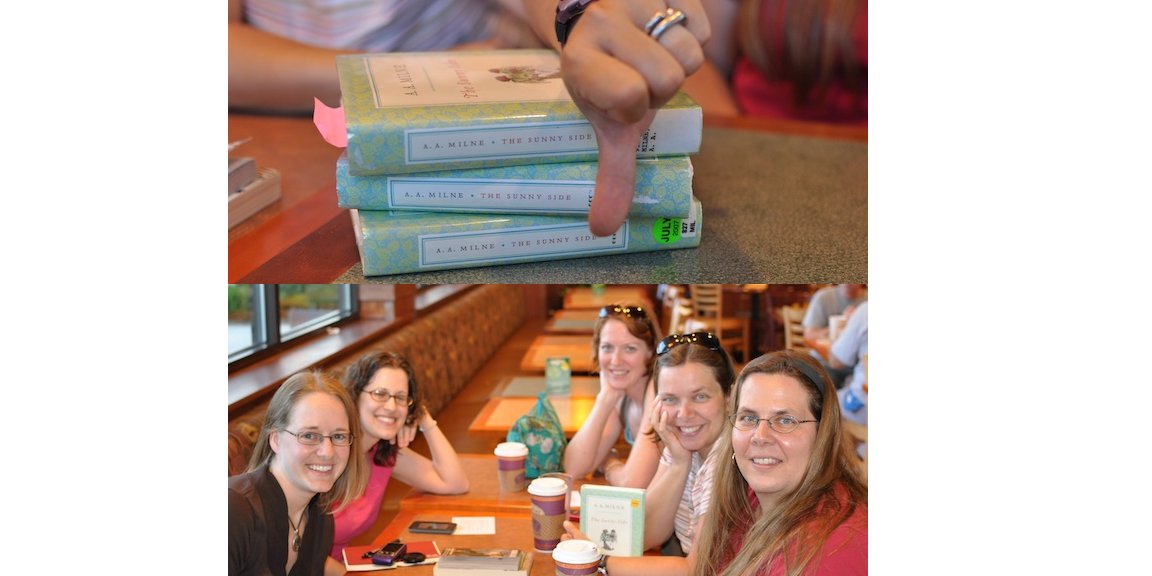
The Sunny Side – a recap

“Reading enlarges my vision of the world; it helps me understand
someone who is different from me. It makes me bigger on the inside.
We tend to see the world from our own perspective;
it is good to see it from the eyes of others.”
Gladys Hunt, Honey for a Child’s Heart.

This is a great explanation of the purpose of our book club. It’s also the reason we choose a book of short stories for this month. Broadening our Horizons. Seeing the world from the eyes of someone else.

None of us are men, none of us have just lived through WWII, and none of us are from England. (that I know of) All of these factors made this book a bit of a challenge for me.

I’ve heard short stories described as “delicious bites of reading for busy people.” I’m so used to reading novels, full of detail and developed characters. This gave me a new taste of a completely different writing style. (I did take a Short Story class back in college, but that’s been some years ago now.) The many cultural and linguistic differences, did make this less of a favorite for a few.

I did find a few “delicious bites ” quite humorous…

The Long Way Down – flippity, flippity flippity. Finding amusement in the small things. Living on the 5th floor is, oh, so much better than a lower level!

Enter Bingo – Oh, the process of naming a dog properly!

Sisterly Assistance – Not being understood is frustrating when it happens to me, hilarious when it happens to someone else!

The Obvious and A Warm Half Hour – husbands think and do things not.like.wives. 🙂

These all came from the section entitled “Home Notes,” a favorite section of the five of us who made it on Monday night. I really enjoyed the small size of our meeting. We even did some reading aloud! Don’t you just love being read to!

In the end I think some would much rather read Milne’s classic Winnie The Pooh stories, but for now I think this book will stay in my collection.

If you were one of those who will not be keeping the book in your collection… maybe you’ve already disposed of it in your choice fashion… good! There are WAY TOO MANY books in the world to finish reading one that you don’t want to! 🙂


Discussion Questions for The Sunny Side

Well, the due date for The Sunny Side is quickly approaching.  It is about this time you need to start cramming or finding Cliff Notes to pass the oral test on Monday night.  Unlike repeating “watermelon” to feign a knowledge of the words in a song . . . The Sunny Side requires a bit of page turning combined with reading.  Due to the shortness of the chapters consider reading while you brush your teeth, grind some grain, or sit on the porcelain bowl. 

To wake you your brain, here are a few questions to ponder before we meet next week.

  1. What was your favorite story or poem?
  2. What attracted you to you favorite story or poem?
  3. What did you learn about the author and the time period from these stories?
  4. Would you recommend this book to a friend? Who in particular? Why?
  5. Where did you read this book?
  6. Which would you rather read:  The Sunny Side or Winnie the Pooh?
  7. Do the characters seem real and believable? Can you relate to their predicaments? To what extent do they remind you of yourself or someone you know?
  8. In what ways do the events in the books reveal evidence of the author’s world view?
  9. Did certain parts of the book make you uncomfortable? If so, why did you feel that way? Did this lead to a new understanding or awareness of some aspect of your life you might not have thought about before?

Enjoy your remaining dates with your book and kudos to those of you who have finished your book!

A sustaining book

My goal is that all the books we select be sustaining ones.

Have you ever thought about a book being “sustaining”?

Have you ever thought if the books you read your children are sustaining?

Many of you are mothers, some are not. Today I’d just like to talk about reading to children… yours, other peoples, everyone’s!

Jodi has blogged about this before, but it’s such an important thing it’s worth a repost! She started her own meme called “If You Give A Mom A Book.” I would encourage you to link up and share what you and the children in your life are reading!

Before I send you to the whole post here’s a snippet…

But what exactly is a Sustaining Book? Gladys Hunt, in her book Honey for a Child’s Heart, quotes Ruth Sawyer’s suggestion of “proper fare for a child’s mind” as

Stories that make for wonder. Stories that make for laughter. Stories that stir one within with an understanding of the true nature of courage, of love, of beauty. Stories that make one tingle with high adventure, with daring, with grim determination, with the capacity of seeing danger through to the end. Stories that bring our minds to kneel in reverence; stories that show tenderness of true mercy, the strength of loyalty, the unmawkish respect for what is good.

I have to strongly second that book! (Honey for a Child’s Heart) It’s often the gift I give to new mothers. My copy is well worn and marked up! Gladys Hunt also has Honey for a Woman’s Heart… another excellent one in my collection!

Take a minute and check out this post of Jodi’s, If You Give A Mom A Book. And here‘s the most current post from the Granola house.

At our house this week we read the old classic Tawny Scrawny Lion. Remember that one?

Happy Reading,
Sarah

currently reading:
The Sunny Side and The Mission of Motherhood

So Much More Than Just "Pooh"

I have to admit that until writing this blog post, I didn’t know much about A. A. Milne, other than he wrote Winnie the Pooh. At that, I never read it or had much attachment to the characters when I was younger (although I do have a rather cute picture of me and Tigger from a visit to Disney World right after high school.) However, after reading the introduction to The Sunny Side and getting a glimpse of Milne’s dry humor, I got excited to find out a little bit more about our author for this month’s book.

So off to Wikipedia I went, where I found out some very interesting facts about A.A. Milne. Here are a few that might be helpful for our discussion and a few that I thought were just plain interesting:

  • Alan Alexander (A .A.) Milne was born in Kilburn, Lindon on January 18, 1882.
  • One of his teachers was H.G. Wells.
  • Milne was a contributor and later an assistant editor of the leading British humor magazine, “Punch.” The Sunny Side is a collection of writings published in “Punch.”
  • In his lifetime Milne wrote more than 25 plays.
  • Milne fought in the British Army in World War I.
  • Milne’s only son Christopher Robin Milne was his inspiration for his Winnie the Pooh books, his most famous works.
  • During World War II, he was a major critic of P. G. Wodehouse (author of The Code of the Woosters, our book club book from December 2009). Wodehouse was captured by the Nazis at his country home in France and interned for a year. Following his release, he made radio broadcasts that were sent from Berlin about his year-long imprisonment. Although his broadcasts poked fun at the Germans and Wodehouse was actually more clueless than traitorous, Milne “accused Wodehouse of committing an act of near treason by cooperating with his country’s enemy.” Wodehouse later got back at Milne through a parody of the Christopher Robin poems.
  • Milne had always wanted to write whatever he wanted, but after the success of the Pooh books, he had a hard time finding an audience for his writings for adults.
  • After a stroke and brain surgery in 1952, Milne retired to his country home where he was an invalid until his death on January 31, 1956.

There’s so much more to Milne than that “silly old bear” that ended up defining his career. I’m glad we’re branching out to discuss one of the lesser-known works from this prolific author. I think A. A. Milne would appreciate it!

See you on June 21 for our discussion on The Sunny Side!

Gwynne

Read it. I know you’ll love it.

One of my life-goals is to become Mary Poppins. I just love her so much I want to be her. She’s a practically perfect sort of magic, and I know just what I’d do when it came time to jump into a chalk picture: hop right into the story of Winnie the Pooh for a rousing game of pooh sticks.

The childish sort of whimsy and randomness that abounds in the stories of Poppins and Pooh is appealing to me, and I was delighted to find that A. A. Milne wrote other things besides stories of Christopher Robin and Pooh Bear. One of them is a collection of “Short Stories and Poems for Proper Grown-ups” called The Sunny Side which we will be discussing in a few short weeks, and just in case you haven’t bought a copy yet, you can do so here.

I’m supposed to be introducing this book to you, but I haven’t read it yet! However, I would say, having not read the book, that this book is ridiculous, charming, truthful, silly, adventurous, and full of delightful tales that are sure to make you feel like a kid again.

Some helpful tips to begin your reading:

*I followed someone’s advice and read the introduction, and I’d like to note that he says NOT to read the first section first. Skip the collection entitled “oranges and lemons” and go straight to “men of letters” (which in my book is on page 57).

*A joint in this story is not illegal drugs, it’s meat. i think.

*Don’t take anything in this book too seriously. They were originally stories written for a British satire magazine.

*Read the introduction.

*Take note of anything that makes you laugh or which is your favorite. I’m sure we’ll want to compare later!

*Go buy the book on amazon if you haven’t yet!

Cheerio!
~Janet