GwtW discussion questions

Our Gone with the Wind discussion is next Thursday, July 28th. Here are a few questions and topics to get you thinking…

1. How do Gerald and Ellen influence Scarlett’s character? What traits does she inherit from each?

2. In what way does Scarlett represent the Old South and in what way does she represent the New South? How does her transformation reflect the changes the South undergoes during and after the Civil War?

3. Compare and contrast Ashley and Rhett. What cultural attitudes or ways of life do they embody?

4. What role does Melanie play in the novel? How and why does her relationship with Scarlett change over time?

5. How are slavery and black people depicted in Gone with the Wind? Can the novel be labeled racist?

6. What values and lifestyles do Tara and Atlanta represent? How does Scarlett change as a result of her interactions with these two settings?

7. Discuss some of Scarlett’s unscrupulous actions—for instance, her employment of convicts in the mill. How does she justify these actions? How do other characters react to her? Does the narrator judge her, defend her, or remain objective?

(via)

Provided the heat doesn’t move us indoors we’ll be meeting at 7:00pm at Geist Park, Fortville. (Be sure to RSVP on facebook so I know to contact you if we move locations.)

May’s meeting seems like so long ago! I’m anxious to get back together and talk about this classic book! Hope you all are having a great summer and staying cool!

Don’t forget to bring a salad to share, as well as your own dishes. I’ll provide drinks.

See you in a week!


The gift of storytelling

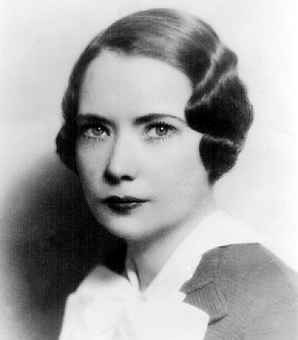
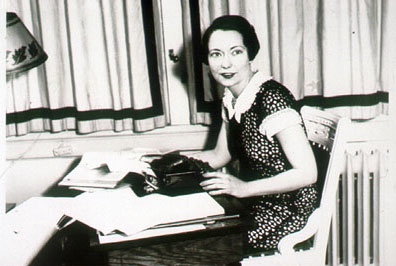
Margaret Mitchell (1900-1949)

Winning a Pulitzer Prize for our current book club novel: Gone With The Wind, her only published novel, she is known by most. Gone With The Wind is on the best-seller list having sold 30 million copies!

Born November 8, 1900 in Atlanta Georgia, she grew up hearing stories of the Civil War which laid the ground work for this masterpiece early on in her life.

In 1922 she took the next step leading to her literary fame when she began writing for the Atlanta Journal, a very uncommon career for a female in that time. In her short time a the paper (’22-’26) she became their leading feature writer.

Believing a husband should support the wife she quit in 1926 to return home and to her fiction when her husband was financially able to support them. Her fiction was the manuscript that would introduce us to Scarlett and Rhett and the war from the Southern point of view. She worked on her novel for roughly 10 years.

A very rough draft was first read by an editor at Macmillian Publishing, Harold Lantham, void of a first chapter, but he new the gem it would become. She, on the other hand, was reluctant to think it would amount to anything, but Lantham promptly sent her a check to encourage her to finish.

Her fame grew quickly as the book was published on June 30, 1936, then winning the Pulitzer Prize in 1937 and the movie released in 1939.

Mark your calendars and join us at 7:00 Thursday July 28th at Geist Park for a picnic and discussion of this epic novel! Bring a salad to share, your own dishes and your lovely selves!

If the past has anything to teach me, the summer goes fast… so I’ll see you all in a few short weeks!!

Happy Reading,
Sarah


Walking Contradiction: An Introduction to Gone with the Wind

From Gone with the Wind Chapter Six:

She heard the soft muffled sound of his footsteps dying away down the long hall, and the complete enormity of her actions came over her. She had lost him forever. Now he would hate her and every time he looked at her he would remember how she threw herself at him when he had given her no encouragement at all… And the thought stung her to a new rage, rage at herself, at Ashley, at the world. Because she hated herself, she hated them all with the fury of the thwarted and humiliated love of sixteen. Only a little true tenderness had been mixed into her love. Mostly it had been compounded out of vanity and complacent confidence in her own charms. Now she had lost and, greater than her sense of loss, was the fear that she had made a public spectacle of herself… Was everyone laughing at her? She began to shake at the thought.

Her hand dropped to a little table beside her, fingering a tiny china rosebowl on which two china cherubs smirked… She picked up the bowl and hurled it viciously across the room to toward the fireplace. It barely cleared the tall back of the sofa and splintered with a little crash against the marble mantlepiece.

“This,” said a voice from the depths of the sofa, “is too much.”

Nothing had ever startled her or frightened her so much, and her mouth went too dry for her to utter a sound. She caught hold of the back of the chair, her knees going weak under her, as Rhett Butler rose from the sofa where he had been lying and made her a bow of exaggerated politeness…

“Sir, you should have made known your presence.”

“Indeed?” His white teeth gleamed and his bold dark eyes laughed at her…

Her temper was beginning to rise again at the thought that this rude and impertinent man had heard everything–heard things she now wished she had died before she ever uttered.

“Eavesdroppers–” she began furiously.

“Eavesdroppers often hear highly entertaining and instructive things,” he grinned. “From a long experience in eavesdropping, I–“

“”Sir,” she said, “you are no gentleman!”

“An apt observation,” he answered airily. “And, you, Miss, are no lady.”

This scene early in Gone with the Wind is one of my favorites in both the book and the movie. Not only do we get a great preview of what many of Rhett and Scarlett’s interactions are going to be like throughout the story, but we get a lot of insight into their characters.

I always enjoyed the movie Gone with the Wind–for nerdy reasons like history is one of my favorite subjects and that it is a groundbreaking example of epic filmmaking–but it was when I read the book for the first time that I really fell in love with the story. It is the story of Scarlett O’Hara, a complicated character, an anti-hero of sorts, full of contradictions and powerful emotions–at the same time driven by love and hate, selfish ambition and loyalty, the desire to be a great lady like her mother and the need to shirk old societal conventions in order to rebuild a life in the South destroyed by the Civil War. The book lets us read Scarlett’s thoughts and gives us insight into her motives that we can only get a glimpse of in the movie. Margaret Mitchell’s brilliant writing makes Scarlett a character you’ll find yourself rooting for as she drives you crazy at the same time.

Please Note: Like our last book, I have to issue a disclaimer about some of the language, but for different reasons. The word d@*n (if you catch my drift) is used by some of the characters, and because it’s set in Georgia during the Civil War and Reconstruction when it would have been a common term, there is use of the “n-word” as well. In my opinion, it doesn’t detract from the story or the novel as a whole, but I wanted to be sure no one has any surprises–especially for those of you who might be listening to the audiobook with kids around. 🙂

Gone with the Wind is a long book, but that’s why we’re taking two months to read it! You still have plenty of time, and it’s a great summer read. We’ll be meeting July 28 at Geist Park for a picnic. I really hope you all enjoy meeting Ashley, Melanie, Aunt Pittypat, Mammy, Rhett, and of course, Scarlett O’Hara.

Happy reading!

A Walk Down Memory Lane.

A week ago we met to discuss Peter Pan, our children’s literature choice for the year. And as we took our minds on a merry trip down memory lane, we took ourselves back to our summer meeting place: Paradise 🙂

DSC_3383
See! summer = blended coffee beverages. yum!

DSC_3384

Our discussion flowed through topics like: what do we really think of Peter? What might the book have to say about a parent’s role in growing imaginative children? Would you want a dog for a nanny? as well as various comparisons between the book and film adaptations.

DSC_3387

One of our favorite aspects of the book was ridiculousness that was peppered amongst the pirate fights and pert pixies.
DSC_3392
Do you know what else is favorite? 1/2 price cookies before closing time!
DSC_3390

Join us for our next meeting! We’re giving you 2 months to tackle this puppy: Gone With The Wind by Margaret Mitchell. It’s a big-un. So, we’re giving you TWO months to read it. So, no excuses? I don’t remember where we’re meeting or when. So just start reading the book, and we’ll fill you in on that later. 🙂

The Boy Who Would Not Grow Up

Wish I could give you some fairy dust this week! …But since I’m not Tinker Bell here are some “lovely thoughts” to get you thinking before book club on Thursday…

“You just think lovely wonderful thoughts, and they lift you up in the air.”

The magic of dreams are never ending! Do you remember your dreams when you wake? What does your Neverland look like?

A dog for a nanny, a mom cleaning and straightening children’s brains… what was your favorite unrealistic part or scene of this story?

The loss of childhood is inevitable, what do you miss most from your youth? When did you loose your ability to fly? Aka: At what point in your life did you start considering yourself an adult? …if you are, in fact, a grown-up 🙂

Assuming you’ve seen the Disney version of Peter Pan, what are your thoughts on the differences? and similarities?

If you are a mother, how do you encourage your children to dream? Also, Mommies of preschoolers this is an excellent resource to accompany the book from Homeschool Creations: Peter Pan Preschool Pack

Peter Pan discussion:
this Thursday May 12th
@ 7:00pm
Paradise Bakery & Cafe

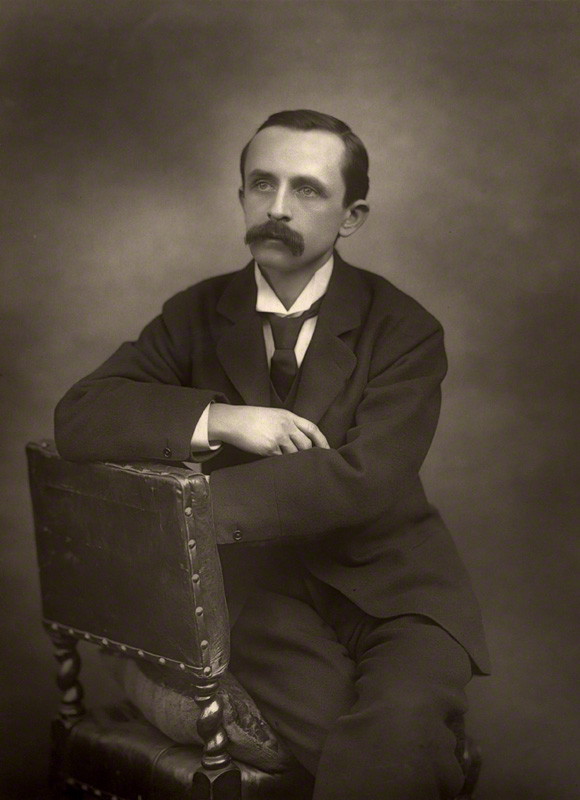
Laughing in the Face of Tragedy: J. M. Barrie

“The combination of laughter and tears, or the effort to make his audience laugh in the face of tragedy, distinguishes all of J. M. Barrie’s writing We encounter the most flawless example of this mixture of humor and heartbreak in Peter Pan—the story of a never-aging boy who takes other children on fantastic adventures and is eventually abandoned by them.” —Amy Billone

James Matthew Barrie was born on May 9, 1860 and was no stranger to tragedy throughout his life. When Barrie was six years old, his older brother David died in a skating accident, an accident that haunted Barrie for the rest of his life, and his mother never fully recovered from the trauma. Barrie had a love for the theater, and was a prolific writer of plays. Two years after his first commercial theatrical success in 1892, he married Mary Ansell, an actress who had performed a leading role in the play. Later he went on to publish novels and a memoir about his mother.

Barrie became good friends with George and Sylvia Llewelyn Davies and their sons George and Jack in 1897, and his playacting with the boys was the principal source of material for his play Peter Pan, which also developed as a novel, Peter and Wendy that is now known as Peter Pan.

Barrie and his wife divorced in 1909, but in 1910, Sylvia Llewelyn Davies died, and because her husband had died in 1907, Barrie adopted all five of their sons. But in the midst of this joy, pain was still to come. George, the oldest boy was killed in World War I. Several years later, the fourth of the Llewelyn Davies boys drowned while swimming in a millpond with a friend. Barrie never recovered from the death, and his writing pretty much ceased after this. Barrie’s last play, which reflected aspects of his life, including the death of his brother was not successful. He died in 1937.

Despite all of this tragedy, J. M. Barrie has created one of the most beloved pieces of children’s literature of all time, filled with fantasy, delight and humor. But as the quote above mentions, it is tinged with some sadness. Nonetheless, I look forward to our journey to Neverland this month with Wendy, John, Michael, Peter Pan and Tinkerbell as we meet Tiger Lily, the Lost Boys and pirates and battle the evil Captain Hook. Let’s all be kids for a while and enjoy this time to “fly”.

See you at Paradise Bakery and Cafe on May 12 at 7 as we discuss Peter Pan!

You Can Fly!

Happy thoughts of this month’s book are lifting me off my feet and into my dreams. Full of whimsy and witty banter, this story is a joy to read as an adult. Peter Pan was a huge hit on the stage before it was transformed into a novel. Children enjoy the story, but the only ones who can truly appreciate the magic of Barrie’s writing are adults willing to tap into their inner child.

What is your childhood fantasy? What would happen if your fantasy came to life? How can you live in the fantasy as an adult? Let Barrie’s story take you on your own magical journey. You already know the way: “Second star on the right and straight on till morning!”

Join us May 12th @ 7pm at Paradise Bakery, Hamilton Town Center. Peter Pan is our young reader for the year. Follow the links to buy it online at Borders (the version I selected has footnotes for some of the British terms). It’s in the public domain so you can find free downloads and audio books online (only in the US) which means e-reader versions should be extremely low-priced.

*disclaimer!!! In my version, Tinker-Bell says a naughty word a few times, and the British language can be tricky to understand here and there. I recommend selecting a children or teen version for reading to your children.

Reading FOR and WITH a Purpose


Recap of our April meeting:
Three Cups of Tea

Where to even begin?

How do I put an experience into words? How do I give it the proper credits their due.

If you would have asked me 5 or 10 years ago I never ever would have guessed I would start a book club. I never could have imagined how much I would enjoy reading good books and discussing them with friends… over TEA!

I would have called you crazy.

Although my cool Aunt Lois always drank tea… I didn’t think that the transparent-watery drink was for me. (Now I’ve learned the joy of a splash of raw milk and honey! My tea is not transparent! And tea is not like water.)

Saturday was a perfect clash of so many favorites coming together!


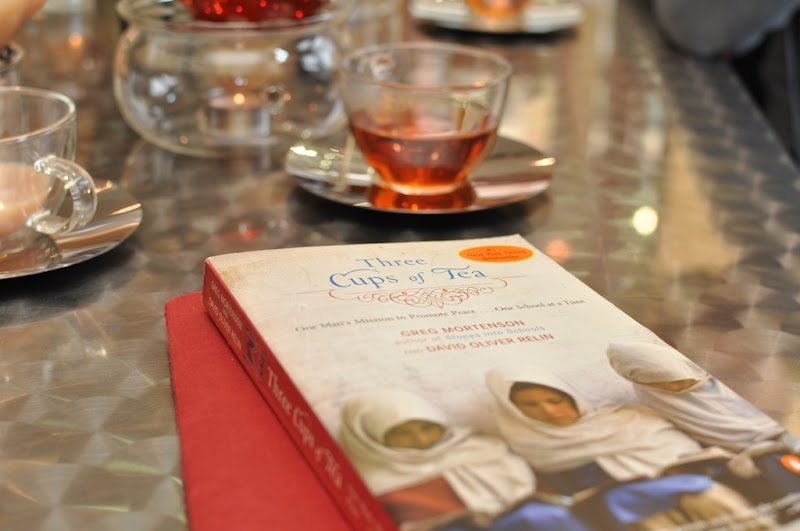
Our discussion of Three Cups of Tea lasted longer than normal but we didn’t notice. Each with our own pot of tea, we were set to enjoy the cloudy day sitting in the cafe. (Mine was a marvelous pot of carmel almond black tea- sweetened and with milk, of course!)

Three Cups of Tea

An amazing feat done by the inspiration of one man.

A wrong turn. A new road for his life.

New schools where there were none.

Hope for the coming generations.

A creative solution for a major issue.

Teaching peace through simple education.


Our discussion questions were a little like essay questions, BUT they provided excellent launching points for our discussion.

One question spurred on part of our conversation…

Greg believes education is the key solution to some very complicated problems. What other problems do you think are in need of some creative solutions?

We agreed most problems, especially the big and complicated ones, should be solved creatively, not by just throwing money at them. The small, tedious steps Greg needed to take to build each school… like how he had to build a bridge to even get to the building site of his first school. Those small, very necessary, steps will probably help really solve problems not just patch them.

We also discussed the following two big problems and the inspired people coming up with creative solutions.

Education in America. If you’re not familiar with Ted Talks you should surf on over there and take a gander. One of many with inspired ideas, Salman Khan is using video to “reinvent education.” You may think that sounds like the opposite direction we need to go. Kids need a human to teach them, talk to them, answer specific questions, right? Well, before you make any judgments see if these short 20 minutes don’t change your mind.

Food. Specifically processed food… I believe another complicated problem in America. We talked about Jamie Oliver and his show Jamie Oliver’s Food Revolution. His current season is focused on promoting healthy eating habits in public schools. Referring to last month’s book, I think food in America is near a tipping point. (Do you agree??) Oliver is teaching about REAL food… you know, the kind that grows in the ground and on trees… people are re-learning how to cook and bake. With actual food.

I’ll stop there before I get higher on my food soap box 🙂 and get back to our book.

We enjoyed reading a different perspective from the middle east. He shared about where he was on 9/11. And what that meant for an American in the Middle East at that time. We enjoyed the details. I really got a good mental picture of the many locations he traveled and the sparse life he lived while trying to collect enough money for schools and airfare. Personally, I would have loved to hear more from his wife’s point of view… but maybe that will be a book in itself some day.

And we discussed much more.

I know many were busy this month, but I wish you could have made it! I encourage you to come next month, May 12th.

Rachel won the door prize… a copy of next month’s secret reveal book…

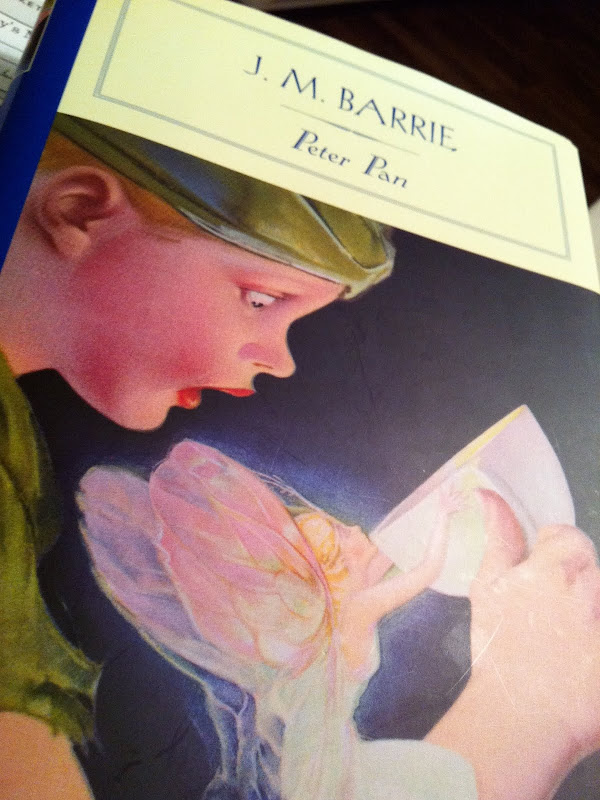
Peter Pan by J. M Barrie

I’m sure you’re familiar with the Disney version of this classic, but have you ever read the original? (Be sure you’re copy isn’t an abridged version… you’ll be missing out! It’s a quick read, you don’t need to get the short version anyway!)

A little fairy dust never hurt anyone. I’m sure you’ll enjoy this book. And I know this children’s book will prove good conversation for our adult book club.

See you in a few weeks!

Three Cups of Tea Discussion "Tea"sers

I know, I know. That title was a terrible pun, but we seem to have a tea theme this month, so I couldn’t resist. We hope you can join us this Saturday at Tea’s Me Café to discuss Three Cups of Tea by Greg Mortenson and David Oliver Relin. 


Here are some questions to get you thinking or to help refresh your memory before we meet. These are taken from the publishers’ website for book clubs:

  1. Relin gives a “warts and all” portrait of Mortenson, showing him as a hero but also as a flawed human being with some exasperating traits. Talk about how Relin chose to write about Mortenson’s character—his choice of details, his perspective, the way he constructs scenes. Is Mortenson someone you’d like to get to know, work with, or have as a neighbor or friend?
  2. At the heart of the book is a powerful but simple political message: we each as individuals have the power to change the world, one cup of tea at a time. Yet the book powerfully dramatizes the obstacles in the way of this philosophy: bloody wars waged by huge armies, prejudice, religious extremism, cultural barriers. What do you think of the “one cup of tea at a time” philosophy? Do you think Mortenson’s vision can work for lasting and meaningful change?
  3. Mortenson’s transition from climbing bum to humanitarian hero seems very abrupt. However, looking back, it’s clear that his sense of mission is rooted in his childhood, the values of his parents, and his relationship with his sister Christa. Discuss the various facets of Mortenson’s character—the freewheeling mountain climber, the ER nurse, the devoted son and brother, and the leader of a humanitarian cause. Do you view him as continuing the work his father began?
  4. The authors write that “the Balti held the key to a kind of uncomplicated happiness that was disappearing in the developing world.” This peaceful simplicity of life seems to be part of what attracts Mortenson to the villagers. Discuss the pros and cons of bringing “civilization” to the mountain community.
  5. Did the book change your views toward Islam or Muslims? Consider the cleric Syed Abbas, and also the cleric who called a fatwa on Mortenson. Syed Abbas implores Americans to “look into our hearts and see that the great majority of us are not terrorists, but good and simple people.” Discuss this statement. Has the book inspired you to learn more about the region?
  6. Have you ever known anyone like Mortenson? Have you ever had the experience of making a difference yourself through acts of generosity, aid, or leadership?
And because those felt a little like what you’d have on an essay test at school (good questions, but still…) here are a few of my own:
  1. Greg found himself in some pretty dangerous situations in the book. Did any of them make you nervous when reading his story?
  2. What stood out to you the most about this book?
  3. Did anything about this book change your views on global politics? Did you learn anything you didn’t know before?
  4. Greg believes education is the key solution to some very complicated problems. What other problems do you think are in need of some creative solutions?
I can’t wait for Saturday! I thoroughly enjoyed last year’s outing. I’m already trying to decide what kind of tea I’ll get this time. Hope to see you all on Saturday at Tea’s Me at 11 a.m.! Until then, Happy Reading!

Mountain Climber, Peace Maker, Story Teller

I just love people who solve problems creatively.

Greg Mortenson is one of these people.

I love reading about ideas that creatively solve problems.

Three Cups of Tea, is about how Greg Mortenson is creatively solving some BIG problems.

I love this quote about him, “Mortenson believes that education and literacy for girls globally is the most important investment all countries can make to create stability, bring socio-economic reform, decrease infant mortality and population explosion, as well as improve health, hygiene, and sanitation standards globally.” (from wikipedia)

Those problems are big, right? I’d say, though, that Greg’s efforts also work towards the often scoffed at ideal of world peace. But any effort that brings discussion, understanding and conversation over violence is a winner in my book. Ergo, this book=winner. 🙂

Read it: Be challenged. Be inspired.

(And for those of you who are less than excited about reading biographical books: this one has mystery, intrigue, suspense, and drama- all in a far away land!)